Timesheet and invoice software case study
How NexaConsulting Reduced Its Client Billing Cycle from 15 Days to 5
A 120-person consulting team unified client timesheets, manager approvals and contractor invoice submission in one structured month-end workflow.
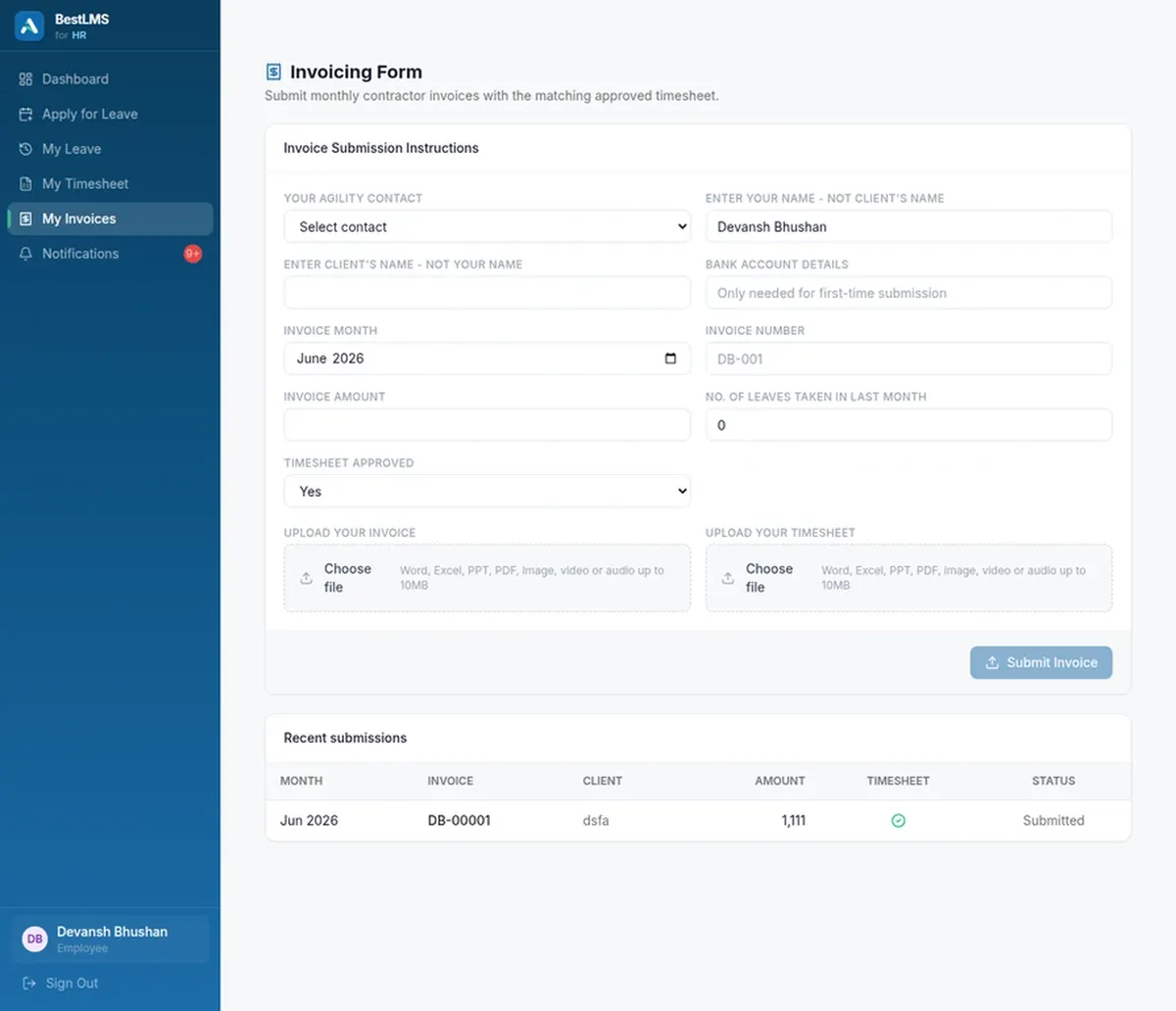
What changed, concretely
- One timesheet per client per person, so hours are attributed on entry
- Continuous saving, so nothing depends on remembering to submit
- Manager approval before anything reaches an invoice
- Contractor invoices generated from approved time, not assembled separately
- Authorised admins can correct an error without a full resubmission
- Client-wise hours available without a separate reporting step
Why did the billing cycle take fifteen days?
Month-end started with collection rather than billing. Hours arrived as Excel files, PDFs and screenshots, each in a slightly different shape, and the first job was working out which client each block of time belonged to. Then came reconciliation: chasing the people who had not sent anything, resolving entries that did not match what a manager remembered approving, and rebuilding totals by hand. Contractor invoices were prepared separately from the timesheets that justified them, so the figure being billed and the figure that had actually been signed off were two different numbers that had to be brought together manually. None of those fifteen days were spent deciding anything. They were spent assembling, chasing and re-checking, and every cycle repeated the same assembly work from the beginning because nothing from last month made this month easier.
How does structured time capture shorten the cycle?
Every employee and contractor gets a separate spreadsheet-style timesheet for each client, so time is attributed as it is entered rather than sorted out later. Hours save continuously as people work, which removes the end-of-month collection scramble: the data is already in one place and already attached to the right client. Managers then review and approve before anything is billed, and approved time flows straight into contractor invoices. That last link is what removes the reconciliation step entirely, because the numbers being billed are the same records a manager signed off, not a separate figure assembled to match them. Finance, managers and contractors all work in the same month-end workflow instead of exchanging files, so shortening the cycle from fifteen days to five is mostly a matter of deleting steps that no longer need to exist.
What does this change for finance and contractors?
Finance stops being a collection function. Because hours are captured against the right client continuously and approvals happen before billing, the month-end job becomes reviewing a prepared position rather than building one. Disputes drop for a structural reason rather than a procedural one: when the invoice is generated from approved time, there is no gap between what was agreed and what was billed for anyone to disagree about. Contractors get the same clarity on the other side, submitting time in a familiar grid and seeing what has been approved rather than waiting to find out whether their invoice matched a spreadsheet assembled elsewhere. For a one-hundred-and-twenty-person consulting team billing across multiple clients, the compounding effect is that each cycle no longer starts from scratch.
What month-end used to feel like
The first three days were not accounting, they were archaeology. Files arrived by email in whatever shape each person preferred, and somebody had to open each one and work out which client the hours belonged to. Some entries were obviously reconstructed from memory, because they had been filled in the night before rather than as the work happened. Then the chasing started: the people who had not sent anything, the entries a manager did not recognise, the totals that did not add up to what anyone remembered agreeing. Contractor invoices were being prepared in parallel from a different source, so two numbers existed for the same work and someone had to decide which was true. By the time billing actually went out, most of the effort had gone into agreeing what had happened rather than invoicing it.
What month-end looks like now
There is no collection phase, because there is nothing to collect. Hours were entered against the right client as the work happened, saved continuously, and approved by a manager during the month rather than after it. The month-end job is reviewing a position that already exists. Contractor invoices are generated from the time that was approved, which means the number being billed and the number that was signed off are the same record rather than two figures that have to be reconciled. The five days that remain are mostly review and judgement: checking edge cases, handling the genuinely unusual entry, confirming the position before it goes out. The ten days that disappeared were assembly work that no longer needs doing.
Why the invoice link matters more than the timesheet
Most timesheet tools stop at capture, and capture is the easy half. The expensive problem is the gap between the hours a manager approved and the figure that eventually appears on an invoice, because every manual step between those two things is a place where they can diverge. Once they diverge, somebody has to investigate, and the investigation costs more than the entry ever did. Generating the invoice from approved time closes the gap structurally rather than procedurally: there is no second number to disagree with the first. That is also why disputes fall rather than merely becoming easier to resolve. A dispute needs two conflicting accounts of the same work, and this removes the second one.
Frequently asked questions
Can contractors and employees use the same timesheet workflow?
Yes. Both get a separate timesheet per client with continuous saving and the same approval flow. Approved contractor time then feeds contractor invoice submission, so the billed figure and the approved figure are the same record.
Does approved time flow into invoices automatically?
Yes, and this is the step that removes month-end reconciliation. Contractor invoices are generated from time a manager has already approved, rather than prepared separately and then matched against timesheets afterwards.
Can admins correct a timesheet after submission?
Authorised admins retain correction control, so a genuine error can be fixed without asking the employee to resubmit or rebuilding the month. Corrections stay visible in the record rather than silently overwriting it.
Do we need a separate tool for client-wise billing?
No. Because each timesheet is already scoped to a client, client-wise hours are a property of how time is captured rather than something produced by a later reporting step.
What stops a timesheet being filled in from memory at month-end?
Continuous saving means time can be recorded as the work happens rather than in one sitting later, and manager approval happens during the month rather than after it. The system does not prevent late entry, but it removes the reason most people did it.
How are hours split when someone works across several clients?
Each person gets a separate timesheet per client rather than one combined sheet divided up afterwards, so attribution happens at the moment of entry instead of becoming a month-end sorting job.